

BreezeMeds GLP-1 Weight Loss 2026: Compounded Semaglutide and Tirzepatide Pricing (From $199), FDA Regulatory Status Examined
A 2026 Informational Overview of the BreezeMeds Compounded GLP-1 Telehealth Weight Loss Platform, Semaglutide and Tirzepatide Medication Formats, Published Pricing Structure, 503A Compounding Pharmacy Framework, Clinical Research Boundaries, and Consumer Verification Considerations for Prescription Weight Management Programs
Marietta, GA, Feb. 27, 2026 (GLOBE NEWSWIRE) -- This article contains affiliate links. If a purchase is made through these links, a commission may be earned at no additional cost to the buyer. This article is an informational overview and does not constitute medical advice. Weight management concerns should be evaluated by a qualified healthcare professional. Compounded GLP-1 medications are prescription medications that require evaluation by a licensed clinician. Prescription approval is not guaranteed. All product details described below are stated as presented by the company and should be verified directly on the official website before any purchasing decision.
If you have been researching GLP-1 weight loss medications in 2026, you already know how confusing the landscape has become. Telehealth platforms, compounded formulations, branded medications, shifting FDA guidance — there is a lot to sort through before you even get to whether a particular program makes sense for your situation. BreezeMeds is one of the platforms that comes up frequently in that research, and this overview is designed to help you understand what it offers, how the pricing works, where the regulatory environment stands right now, and what is worth verifying before you enroll.
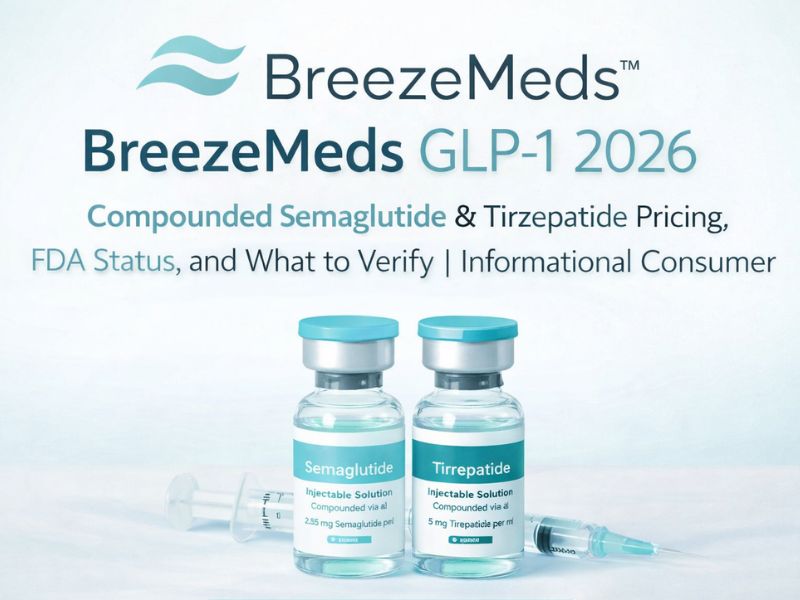
These compounded formulations are not FDA-approved finished products, and individual outcomes are not guaranteed.
Current program details, medication availability, and pricing can be confirmed by viewing the current BreezeMeds offer (official BreezeMeds page).
What BreezeMeds Is: Platform Overview and Compounding Classification
BreezeMeds is a direct-to-consumer telehealth platform that connects individuals with licensed healthcare providers and partner compounding pharmacies for access to prescription GLP-1 weight loss medications. The platform is operated by Breezemeds, Inc. and offers compounded semaglutide injections, oral semaglutide, and oral tirzepatide according to its website.
The company describes the program as medically supervised weight loss personalized to each patient through a fully online process. If you are picturing a traditional doctor's office experience, this is not quite that — it is a telehealth model where you complete a health assessment online, a licensed provider reviews your information and determines whether a prescription is appropriate, and medication ships to your door. That convenience is the core value proposition, but it also means understanding what you are getting and what the limitations are compared to in-person care.
The compounding distinction matters here. BreezeMeds' medications are compounded formulations prepared by licensed pharmacies based on individual prescriptions. That means they are not FDA-approved as finished products. They have not been reviewed by the FDA for safety, effectiveness, or quality as finished formulations, and they are not generic equivalents of FDA-approved branded GLP-1 medications. The compounded nature of these medications does not, by itself, establish safety, effectiveness, or quality for any specific preparation. Consumers should rely on prescriber guidance and verify the dispensing pharmacy's licensing and compliance disclosures.
BreezeMeds Medication Formats and Published Pricing
One area where BreezeMeds differentiates itself is format variety. According to the company's website as of February 2026, the platform lists the following published starting prices by medication format:
Compounded Semaglutide Injection: starting at $199 per month, described as one injection per week.
Compounded Oral Semaglutide: starting at $299 per month, described as one dissolvable tablet per day.
Compounded Oral Tirzepatide: starting at $399 per month, described as one dissolvable tablet per day.
Sermorelin Injections: starting at $100, listed separately from the GLP-1 medication offerings.
The company advertises FSA and HSA eligibility and states that no subscription is required, according to promotional materials on the website. That said, pricing and program terms are subject to change and may vary based on clinical evaluation, dosing, and individual health factors. The latest details should be confirmed directly on the official website before enrolling.
Consumers can confirm current pricing and availability by viewing the current BreezeMeds offer (official BreezeMeds page), as pricing may change at any time.
The FDA Regulatory Landscape for Compounded GLP-1 Medications in 2026
This is arguably the most important section in this entire overview, because the regulatory environment has shifted in ways that directly affect anyone considering a compounded GLP-1 program right now — not just BreezeMeds, but every platform in this category.
Public FDA communications indicate the following: the semaglutide drug shortage was officially resolved in February 2025, and tirzepatide was removed from the shortage list in late 2024. Under the Federal Food, Drug, and Cosmetic Act, compounding pharmacies are generally prohibited from producing drugs that are essentially copies of commercially available FDA-approved products. During the shortage, that rule was relaxed. Now it is not.
There are limited exceptions under Section 503A that allow compounding when a prescriber determines a patient's specific medical needs cannot be met by an FDA-approved drug. That is a narrower pathway than what existed during the shortage era, and it is the legal framework that platforms like BreezeMeds currently operate within.
Public reporting indicates the FDA sent warning letters to more than 50 entities in September 2025 related to GLP-1 compounding promotion and labeling concerns. Separately, the National Advertising Division reviewed advertising claims from several telehealth platforms offering compounded semaglutide and recommended modification or discontinuation of certain claims. As of February 2026, the FDA has signaled increased enforcement attention toward certain non-FDA-approved GLP-1 offerings, and the permissibility of compounding depends on patient-specific clinical need and evolving enforcement priorities.
What does this mean practically? It means the long-term availability of compounded GLP-1 programs is not guaranteed. Regulatory interpretations and enforcement priorities may change. Before enrolling in any platform, it is worth confirming the current program structure and regulatory posture with a healthcare provider.
How the BreezeMeds Program Works: The Three-Entity Model
One thing that often confuses people about telehealth weight loss platforms is that the company name on the website, the provider writing the prescription, and the pharmacy shipping the medication are typically three separate entities. Understanding this structure helps set realistic expectations about what you are actually signing up for.
BreezeMeds (Breezemeds, Inc.) functions as the telehealth technology platform. It provides the website, the intake process, customer support, and the coordination that connects you with a provider and pharmacy. It is not itself a healthcare provider.
Licensed Medical Providers are independent healthcare professionals who review patient health information and determine whether a GLP-1 prescription is clinically appropriate. The platform describes all providers as licensed and based in the United States. Prescription approval is never guaranteed — that decision rests entirely with the evaluating clinician.
Partner Compounding Pharmacies fulfill prescriptions written by the medical providers. According to the company's website, these are 503A pharmacies that are primarily regulated by state boards of pharmacy and operate within a federal framework under the FD&C Act; FDA oversight and enforcement authority may apply depending on circumstances. Per the platform's materials, medication ships with free, discreet delivery.
This three-entity structure is common in the telehealth category. Understanding who is responsible for prescribing, dispensing, and support can help set expectations, especially if questions about your prescription, your medication quality, or your refund come up later.
503A vs. 503B Pharmacies: What the Difference Means for Compounded GLP-1 Medications
For anyone doing their homework on a compounded medication platform, the terms 503A and 503B will come up, and understanding the difference is worth the time.
503A pharmacies are traditional state-licensed compounding pharmacies that prepare medications based on individual patient prescriptions — one prescription, one patient. They are primarily regulated by state boards of pharmacy, with FDA oversight and enforcement authority applicable under certain circumstances. 503B outsourcing facilities operate under a different federal framework, can produce compounded medications in larger batches, and are subject to more direct FDA oversight including current good manufacturing practice (cGMP) requirements.
BreezeMeds states its partner pharmacies are 503A facilities. The practical step is verifying the licensing status of the pharmacy that will prepare the medication. State board of pharmacy websites typically allow license verification by pharmacy name or license number.
Eligibility, Medical Review, and Why Prescription Approval Is Not Guaranteed
Not everyone who applies through a GLP-1 telehealth platform will receive a prescription. Prescription decisions should be based on clinician evaluation, medical history, and individual risk factors.
While BreezeMeds does not prominently list specific eligibility criteria on its main landing page, GLP-1 medications for weight management are generally prescribed based on factors including body mass index (BMI), the presence of weight-related health conditions, medication history, and individual clinical risk factors. The evaluating provider makes that determination based on the information you submit during the intake process.
If a provider determines you do not qualify, the company states that a full refund is issued. Consumers should confirm eligibility-stage refund timing in the platform's published terms before paying, because refund terms can vary depending on how far into the process you have progressed when the determination is made.
It's worth noting that a telehealth assessment, while convenient, may not capture everything an in-person exam would. If you have complex health conditions, are taking multiple medications, or have concerns about how a GLP-1 medication might interact with existing treatments, an in-person evaluation with your primary care provider may be a more thorough starting point.
Marketing Claims vs. Clinical Evidence: How to Interpret Published Weight Loss Statistics
This is the section where it's especially important to be precise, because there's a meaningful gap between what you'll see on a platform's marketing page and what has actually been established through clinical research.
What BreezeMeds' Website States (Company Claims)
BreezeMeds' website references several weight loss statistics in describing its program, including statements that patients may lose "15-20%" of body weight and related percentage-based milestones. The site also references figures such as "85% of patients lose 10% body weight," "60% lose 15%," and "50% lose 20%." These figures are presented in the company's marketing materials and have not been independently audited for this overview. Branded clinical trial results do not establish compounded product equivalence. Consumers evaluating these claims may wish to ask whether the platform's figures are based on internal tracking, third-party audits, or generalized trial summaries. Nothing in these marketing statements should be interpreted as a guarantee of outcomes, and they do not substitute for prescriber-provided counseling.
The company also advertises that more than 50,000 patients have used the platform. This figure is presented by the company and has not been independently verified for this overview.
Some marketing materials in the GLP-1 telehealth category reference weekly weight loss ranges — for example, "1-2 pounds per week." Statements like these should be interpreted as generalized promotional framing rather than guaranteed outcomes. Actual results vary substantially by individual, dose titration, adherence, baseline health, and clinician-directed care.
What FDA-Approved Trials Actually Studied (Branded Products)
Large clinical trials of FDA-approved branded injectable semaglutide reported that participants achieved an average body weight reduction of approximately 15% versus placebo over 68 weeks in the STEP-1 trial. Tirzepatide clinical trials (SURMOUNT-1) reported average body weight reduction of up to approximately 22% at the highest dosing level over 72 weeks. These trials were conducted under controlled conditions with specific FDA-approved branded formulations, extensive monitoring, and defined protocols.
Importantly, these results were observed using FDA-approved branded formulations under controlled trial protocols. They do not establish product-level effectiveness, equivalence, or quality for compounded preparations.
Why Compounded Formulations Are Not Automatically Comparable
The active ingredients in compounded GLP-1 formulations are the same as their branded counterparts, but that does not make them identical products. These preparations are not FDA-approved finished products and have not been evaluated for bioequivalence to branded medications. Formulation differences — including concentration, excipients, and pharmacy-specific preparation methods — may exist between compounded and branded versions.
This is not meant to be alarming. It's meant to be accurate. The ingredient-level research is real, but extending branded trial conclusions directly to compounded formulations goes beyond what the evidence supports. That distinction matters for making an informed decision about any compounded GLP-1 program.
Comparing GLP-1 Access Pathways in 2026
For those weighing their options, it helps to understand the three main ways people access GLP-1 weight loss medications right now, because they differ in regulatory status, cost, and the level of clinical oversight involved.
FDA-approved branded GLP-1 medications through traditional healthcare have undergone the FDA's full review process for safety, efficacy, and manufacturing quality. They carry specific FDA-approved indications and extensive clinical trial data. Cash-pay list prices for branded GLP-1 medications can exceed $1,000 per month without insurance, though manufacturer savings programs and insurance coverage may reduce out-of-pocket costs for eligible patients.
Telehealth platforms offering compounded GLP-1 medications — including BreezeMeds — facilitate access through licensed compounding pharmacies based on individual prescriptions. Pricing across this category typically ranges from $199 to $499 per month depending on format and dosing. These medications are not FDA-approved as finished products and have not been evaluated for bioequivalence to branded formulations.
In-person physician-prescribed treatment may include either branded or compounded medications and often provides more comprehensive monitoring — lab work, physical examinations, and ongoing follow-up that telehealth-only models may not include in their standard programs.
What to Ask a Telehealth GLP-1 Provider Before Paying
Before committing financially to any telehealth GLP-1 program, there are several questions worth asking that can help you evaluate whether the platform is a good fit for your situation.
Which pharmacy will compound my medication, and can I verify its license? Knowing the pharmacy name and checking its status through your state board of pharmacy takes a few minutes and gives you an independent verification point beyond what the platform itself tells you.
What happens if the prescriber determines I'm not eligible? Understanding the refund process and timeline before you pay is important, because policies can differ depending on where you are in the enrollment process when a decision is made.
What ongoing monitoring is included after the initial prescription? Some platforms include regular provider check-ins, dosing adjustments, and messaging access. Others provide the initial prescription with limited follow-up. The level of ongoing oversight matters, especially during dose titration.
Is this a subscription, and what are the auto-renewal terms? Even if a platform advertises "no subscription required," it's worth confirming the exact payment structure, whether charges recur automatically, and what the cancellation process looks like.
What is the compounded formulation, and how does it differ from the branded product? You're entitled to understand what you're receiving. A reputable platform should be transparent about whether its formulations include additional ingredients (such as B12 or other compounds) and how the preparation differs from FDA-approved versions.
Refunds, Cancellation, and Shipping: Where Consumers Commonly Have Questions
Refund and cancellation terms are one of the areas where consumers across the telehealth GLP-1 category most frequently report confusion. The specifics vary by platform, and BreezeMeds is no exception.
The company states that if a provider determines you do not qualify for a prescription, a full refund is issued. The specific timing and process for that refund should be confirmed on the official website before enrolling. What is less clear from publicly available materials is what happens if you qualify and receive medication but later want to discontinue — whether partial refunds are available, whether unused medication can be returned, and what the specific cancellation window looks like.
On shipping, the company advertises free, discreet delivery. For shipped medications, it may be worth confirming whether temperature controls apply to the specific formulation being dispensed, as some compounded injectable preparations may have storage and handling requirements during transit.
A practical consideration: read the full terms of service before paying, not after. The refund section is typically the most consequential part of any telehealth enrollment agreement.
Safety Considerations and Adverse Event Awareness
GLP-1 receptor agonists carry known side effect profiles that are worth understanding before beginning any treatment, whether through branded or compounded formulations. Commonly reported side effects in clinical trials of FDA-approved GLP-1 medications include nausea, vomiting, diarrhea, constipation, and abdominal discomfort. These gastrointestinal effects are typically most pronounced during initial dosing and the titration period as the body adjusts.
More serious potential risks discussed in FDA-approved prescribing information for branded GLP-1 medications include pancreatitis, gallbladder problems, kidney issues, and potential thyroid tumor risk based on animal studies. GLP-1 medications should not be used during pregnancy or breastfeeding. Individuals with a personal or family history of medullary thyroid carcinoma or Multiple Endocrine Neoplasia syndrome type 2 should not use these medications.
If you experience side effects while on a compounded GLP-1 medication, the prescribing clinician and the dispensing pharmacy are your first points of contact. For severe or emergency symptoms — difficulty breathing, severe abdominal pain, signs of allergic reaction — seek emergency medical care immediately regardless of your telehealth program status. This overview is not exhaustive and does not replace the safety information provided with your prescription.
Consumer Questions About BreezeMeds
Is BreezeMeds a healthcare provider or a telehealth platform?
Based on publicly available information, BreezeMeds operates as a telehealth platform that connects consumers with licensed healthcare providers. Medical decisions and prescribing are handled by independently licensed clinicians, not by the platform itself. This distinction can be confirmed in the company's terms of service.
Are BreezeMeds medications the same as FDA-approved branded GLP-1 medications?
They are not the same products. The compounded versions contain the same active ingredient (semaglutide or tirzepatide) but are prepared by compounding pharmacies and have not been evaluated by the FDA as finished products. Differences in formulation, concentration, and preparation methods may exist between compounded and FDA-approved branded versions.
What does "no subscription required" mean in practice?
The company's promotional materials state that no subscription is required. It's worth confirming whether this means single purchases are available, whether ongoing treatment involves recurring payments, and what the specific payment and renewal terms are before committing financially.
Does BreezeMeds accept insurance?
The company advertises FSA and HSA eligibility. Whether the platform accepts traditional health insurance or operates primarily on a cash-pay basis should be confirmed directly, along with FSA/HSA eligibility through your specific plan administrator.
What is the current regulatory status of compounded GLP-1 medications?
As of February 2026, the FDA has resolved the semaglutide drug shortage and has signaled increased enforcement attention toward certain non-FDA-approved GLP-1 products. The permissibility of compounding depends on patient-specific clinical need and evolving enforcement priorities. Current regulatory status should be verified with a healthcare provider and the platform before enrolling, as this landscape can change.
How does BreezeMeds pricing compare to branded GLP-1 medications?
Published starting prices range from $199 to $399 per month depending on medication format. Cash-pay list prices for FDA-approved branded GLP-1 medications can exceed $1,000 per month without insurance, though manufacturer savings programs and insurance coverage may reduce branded costs for eligible patients. Price alone should not be the determining factor — regulatory status, clinical oversight, and pharmacy quality all factor into the overall value equation.
What should I do if I experience side effects?
Contact the prescribing clinician and the dispensing pharmacy as your first step. For severe symptoms — difficulty breathing, severe abdominal pain, signs of allergic reaction — seek emergency medical care immediately. You can also report adverse events to the FDA through its MedWatch reporting system.
Can GLP-1 medications interact with other prescriptions I'm taking?
GLP-1 medications may interact with other prescriptions, including diabetes medications, blood thinners, and certain oral medications whose absorption may be affected. It is important to disclose your complete medication list, including over-the-counter supplements, during the intake assessment. The prescribing clinician should evaluate potential interactions as part of the consultation.
Additional Consumer Research
Additional independent research across multiple consumer publications and medical information sources may provide broader perspective on compounded GLP-1 telehealth platforms, prescription weight loss medications, and the current regulatory environment. Evaluating multiple sources can be helpful before making any enrollment or purchasing decision involving prescription medications.
Summary of Key Considerations
BreezeMeds operates as a telehealth platform offering compounded GLP-1 weight loss medications with published pricing starting at $199 per month for injectable semaglutide, $299 for oral semaglutide, and $399 for oral tirzepatide, according to the company's website as of February 2026. The platform uses a three-entity model — telehealth platform, independent licensed providers, and 503A partner pharmacies — to facilitate access to prescription weight management medications through a fully online process.
Compounded GLP-1 medications are not FDA-approved finished products and have not been evaluated by the FDA for safety, effectiveness, or quality as finished formulations. The regulatory landscape for compounded GLP-1 access has narrowed since the FDA resolved the semaglutide shortage in 2025, and current permissibility depends on patient-specific clinical need and evolving enforcement priorities. Verifying pharmacy licensing, provider credentials, refund terms, and the current regulatory posture of any platform may be worth considering before enrolling.
Complete product details, current pricing, and published terms are available by viewing the current BreezeMeds offer (official BreezeMeds page).
Contact Information
Company: BreezeMeds
Website: https://www.breezemeds.com/
Email: support@breezemeds.com
Operated by: Breezemeds, Inc.
Disclaimers
Content and Consumer Information Disclaimer: This article is an independent informational overview and does not constitute medical, financial, or legal advice. All product details, pricing, program descriptions, and company claims referenced in this article are stated as presented by the company's publicly available materials and have not been independently audited or verified unless specifically noted. All details should be confirmed directly on the official website and with a licensed healthcare professional before making any purchasing or treatment decisions.
Compounded Medication and FDA Regulatory Notice: The medications discussed are compounded prescription medications prepared by licensed pharmacies based on individual prescriptions. Compounded medications are not reviewed or approved by the FDA as finished products. They are prepared using active pharmaceutical ingredients under the direction of a prescribing clinician. Compounded drugs are not generic equivalents of FDA-approved branded medications. Whether an FDA-approved option is appropriate should be discussed with a licensed clinician. As of February 2026, the FDA has resolved the semaglutide drug shortage and has signaled increased attention to certain non-FDA-approved GLP-1 offerings. The permissibility of compounding depends on patient-specific clinical need and evolving enforcement priorities. Regulatory status is subject to change.
Results, Pricing, and Product Variability: Individual results vary based on adherence, baseline health, clinical factors, and clinician-directed dosing. Weight loss statistics referenced on the company's website appear to reflect general GLP-1 clinical trial data from FDA-approved branded medications studied under controlled conditions and do not constitute BreezeMeds-specific outcome data unless independently verified. Branded trial results do not establish product-level effectiveness, equivalence, or quality for compounded preparations. Pricing, program terms, medication availability, and promotional offers are subject to change without notice. Current details should be verified through the official website before enrolling.
FTC Affiliate Disclosure and Publisher Responsibility: This article contains affiliate links. If a purchase is made through these links, a commission may be earned at no additional cost to the buyer. This compensation does not influence the accuracy, neutrality, or integrity of the information presented. The publisher is responsible for the content of this article. The telehealth platform's role as the service provider does not constitute an endorsement of this article or any claims made in its promotion.

support@breezemeds.com

Legal Disclaimer:
EIN Presswire provides this news content "as is" without warranty of any kind. We do not accept any responsibility or liability for the accuracy, content, images, videos, licenses, completeness, legality, or reliability of the information contained in this article. If you have any complaints or copyright issues related to this article, kindly contact the author above.
